
Comparative Consciousness Program
Toward understanding a fundamental nature of consciousness through a comparative lens
From Discussion to Research
As discussions within the ACC meetings evolved, participants increasingly recognized the need for a more systematic research framework capable of guiding empirical work on consciousness across species.
One important step in this direction was the development of the Kathmandu List of Consciousness Tests (C-Tests) — a set of proposed experimental paradigms aimed at investigating conscious processes in animals.
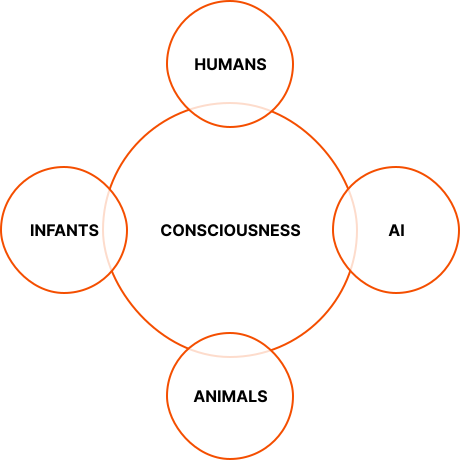
These developments gradually revealed the necessity of moving toward a comparative research framework capable of advancing the scientific understanding of general properties of consciousness across different kinds of minds.
This realization has led to a new phase of the AnyMinds Project — the Comparative Consciousness Program aimed at transforming the insights of the ACC meetings into a structured research agenda.
Research Directions
1. One central line of work concerns the development and systematic application of comparative experimental paradigms for identifying and studying conscious processes in animals.
An initial step in this direction was the formulation of the Kathmandu List of Consciousness Tests (C-Tests) — a set of proposed experimental paradigms designed to identify behavioral and cognitive signatures of consciousness.
Applied across different species, such paradigms may generate increasingly systematic knowledge about the organization of conscious processes in different kinds of minds.
2. A second line of work concerns the investigation of cognitive and neural mechanisms of consciousness using experimental approaches that are difficult or impossible to apply in human research alone.
Combining these two directions — comparative experimental paradigms and mechanistic investigation — may make it possible to study the same conscious processes across species and across levels of analysis. In this way, behavioral experiments, neurobiological methods, and theoretical models can progressively converge in explaining how conscious processes are organized and realized in different kinds of minds.
Toward a Comparative Science of Consciousness
Understanding the nature of consciousness remains one of the most profound open challenges in contemporary science. Despite decades of philosophical debate and neuroscientific research, we still lack a coherent scientific framework capable of explaining how consciousness is realized in minds capable of subjective experience.
Much of the modern scientific study of consciousness has focused on the human mind — the only mind whose conscious nature we can know with certainty from direct experience. While this research has produced many important insights, it also faces intrinsic limitations. A deeper scientific understanding of consciousness may ultimately require a broader comparative perspective — one that investigates how conscious processes may be realized across different kinds of minds.
Yet despite growing interest in consciousness research, the field still lacks a clear empirical program capable of guiding systematic investigation across diverse kinds of minds. The AnyMinds Project was conceived as a framework for developing this perspective and advancing a comparative research program aimed at understanding the fundamental nature of consciousness itself.
The Problem
During the last three decades, the modern scientific study of consciousness has largely been organized around the search for neural correlates of consciousness (NCC), primarily investigated in the human brain. This research program aimed to identify specific neural processes reliably associated with conscious experience.
While this line of research has produced many important findings, it has not yet led to the identification of definitive neural correlates capable of explaining the fundamental nature of conscious experience. Increasingly, it has become clear that empirical correlations alone cannot resolve the problem of consciousness without a coherent theoretical framework capable of explaining how conscious experience is generated and organized.
In response, the field has entered a second phase characterized by an intense search for theories of consciousness. Over the past two decades, a rapidly growing number of theoretical models have been proposed. The Landscape of Consciousness project currently lists more than 300 competing theories, reflecting both the vitality of the field and the absence of a widely accepted explanatory framework.
Recent efforts have attempted to address these theoretical disagreements through coordinated empirical testing. Initiatives such as the Templeton Foundation Adversarial Collaboration Project have brought together proponents of competing theories to test their predictions in shared experimental paradigms, largely within human cognitive neuroscience methodologies. Yet these efforts have so far produced mixed results: different experiments appear to support different theoretical interpretations, and no single framework has clearly emerged as decisive.
As a result, the field today faces an increasingly evident problem. Despite remarkable progress in neuroscience and cognitive science, we still lack a clear empirical research strategy capable of systematically advancing our scientific understanding of consciousness. At the same time, the absence of decisive theoretical and empirical resolution has opened the door to a growing proliferation of speculative proposals, increasingly blurring the boundary between scientific inquiry and speculation.
For this reason, there is a growing need for conceptual and experimental strategies capable of opening new avenues for empirical and theoretical investigation of consciousness and guiding its future development.
A Lesson from the History of Memory Research
At the end of the nineteenth century, pioneering work by Hermann Ebbinghaus and later by Müller and Pilzecker revealed fundamental properties of human memory, including the dynamics of forgetting and the process of memory consolidation. Yet for decades, progress toward understanding these phenomena remained limited, largely because they were known only for humans.
A decisive breakthrough occurred in the mid-twentieth century when it became clear that the fundamental mechanisms of memory consolidation identified in humans were also present in animals.
This realization marked an important conceptual shift: animals could now be studied not merely to understand processes of learning, but as organisms sharing with humans the biological mechanisms underlying various forms of memory — the formation and stabilization of experience itself.
This “aha moment” opened the possibility of experimentally investigating the biological foundations of memory across species, using methods that could not be applied in human research.
As a result, memory research rapidly evolved into one of the most successful interdisciplinary fields in modern science, integrating psychology, neuroscience, and biology.
A Similar Opportunity for Consciousness Research
The study of consciousness may now be approaching a comparable breakthrough moment.
In particular, the growing recognition that animals may possess forms of consciousness suggests a similar “aha moment” for the field. Just as the extension of memory research beyond humans transformed the study of memory, extending the study of consciousness to non-human minds may open fundamentally new avenues for investigating its biological and cognitive foundations.
First, investigations of conscious processes in animals may provide experimental access to mechanisms that remain difficult to study within the limits of human research alone. Second, they may help reveal universal properties of consciousness shared across different kinds of minds.
Developing such a comparative approach is therefore not merely an expansion of existing research. It may represent a step toward understanding the fundamental nature of conscious experience itself.
The Comparative Consciousness Program represents a step toward building such a constructive research framework. It aims to advance the scientific understanding of consciousness across different kinds of minds through coordinated empirical and theoretical efforts.
In a more intuitive formulation, one might recall a recent remark by Tim Bayne:
“If Bill Gates gave me $100 billion tomorrow and said, ‘Find out about consciousness,’ I wouldn’t know what to do with that money.”
One of the ambitions of the Comparative Consciousness Program is to address this challenge — to contribute to the development of a research program that would allow scientists studying consciousness to say:
We know what to do
Developing Comparative Tests for Animal Consciousness
This work outlines an emerging comparative research program, moving from the initial formulation of candidate tests to their systematic evaluation and experimental implementation across species.
Kathmandu, 2024
Kathmandu, 2024
At the Kathmandu Conference (2024), participants initiated a structured effort to formulate and explore candidate experimental approaches to the study of consciousness in animals.
Participants were organized into four breakout groups and tasked with proposing candidate tests that would meet a shared set of conceptual and methodological criteria. These criteria were designed to ensure that the proposed paradigms would be both experimentally tractable and theoretically relevant to the study of conscious processes across species.
The criteria guiding this work are summarized below.
Criteria for candidate C-tests
| # | Criterion | |
|---|---|---|
| 1 | Applicable to different species (for at least two taxa) | + |
| 2 | Does not require complex and expensive equipment | + |
| 3 | Simple in design and does not take much time to perform | + |
| 4 | Applicable both in a lab and in field conditions | + |
| 5 | Documented objectively, preferably multimodally | + |
| 6 | Has a potential to be used in neurobiological studies | + |
| 7 | Adaptable from a 'gold standard' consciousness test in humans | + |
Each group developed a set of candidate paradigms, which were then presented and discussed in a joint session. Through this collective process, an initial set of potential C-tests was formulated — representing, in the shared judgment of the participants, the most promising directions for further development.

Table of candidate C-tests developed by one of the breakout groups
A Kathmandu List of Potential Tests for Animal Consciousness (C-Tests)
1. Hedonic Preference Behavior Test
2. Analgesia Seeking Test
3. Reversal Learning Test
4. Kathmandu Source Modality Test (KSMT)
5. Magic Effect / Deception Test
6. Metacognition Test
7. Self-Embodiment Test
8. Trace Conditioning Test
9. Binocular Rivalry Test
10. Match-to-Sample Test
11. Mirror Self-Recognition Test (MSR)
12. Krushinsky Test
1. Hedonic Preference Behavior Test
2. Analgesia Seeking Test
3. Reversal Learning Test
4. Kathmandu Source Modality Test (KSMT)
5. Magic Effect / Deception Test
6. Metacognition Test
7. Self-Embodiment Test
8. Trace Conditioning Test
9. Binocular Rivalry Test
10. Match-to-Sample Test
11. Mirror Self-Recognition Test (MSR)
12. Krushinsky Test
This work marked a first step toward the development of a systematic comparative framework for the empirical study of consciousness across species, and was further developed at the Galapagos Conference (2025).
Galapagos Islands, 2025
At the Galapagos Conference (2025), participants extended this effort by systematically evaluating and comparing candidate C-tests using an expanded set of conceptual and methodological criteria.
This process allowed for a more systematic comparison of the proposed paradigms and the identification of their relative strengths and limitations.
The criteria used for this evaluation are summarized below.
Criteria for evaluation and ranking of candidate C-tests
- Species generality — applicability across phylogenetically distant species
- Sensory/motor compatibility — independence from specific sensory or motor abilities
- Training dependence — minimal requirement for prolonged training
- Theory dependence — independence from specific theoretical frameworks
- Confidence — interpretability as evidence of consciousness
- Invasiveness — minimal disruption of physiological processes
- Neurobiological applicability — suitability for neurobiological investigation
The results of this comparative evaluation are presented in the figure below.

Comparative profiles of candidate C-tests across evaluation criteria, showing their relative strengths and limitations (Galapagos Conference, 2025).
Together, these analyses provide a first structured comparison of candidate C-tests and help define priorities for their further experimental development.
Next steps
At the upcoming Animal Consciousness Conference (ACC 2026, Chengdu), this line of work will be further advanced by focusing on the candidate C-tests that received the highest evaluations in the Galapagos comparative analysis.
The aim will be to explore in greater detail the possibilities for implementing these paradigms across different animal species, including the identification of feasible experimental designs and species-appropriate adaptations.
In parallel, particular attention will be given to the potential of these tests for investigating underlying neurobiological mechanisms, with the goal of integrating behavioral and neural approaches within a comparative framework.